
How to Choose the Right Mixing Machine for Global Sourcing?
Choosing the right Mixing Machine for global sourcing is a process decision, not a catalogue exercise. The equipment must match materials, batch size, viscosity, hygiene requirements, and local service conditions.
Grand View Research estimated the global industrial mixers market at approximately USD 7.9 billion in 2022. Its report also identifies food, chemicals, pharmaceuticals, and other process industries as important demand areas. MarketsandMarkets similarly highlights automation, customized production, and energy efficiency as major market influences. These figures show opportunity, but they do not identify the best machine for every factory.
John Bridgwater, a recognized authority in powder and particle mixing, described mixing as “the process of reducing non-uniformity.” That short definition is useful during supplier evaluation. A machine that runs quickly may still produce uneven color, moisture, or active ingredients. A smaller mixer may reduce waste, but it could increase cycle time. The cheapest quotation can become expensive after installation.
Buyers should request application trials using their actual materials. Observe discharge behavior, cleaning time, dust control, temperature rise, and batch consistency. Ask for test data, motor specifications, spare-parts availability, and references from comparable plants. Confirm electrical standards, documentation, commissioning support, and maintenance response before signing.
Supplier claims need evidence.
I would not rely on market growth alone. Reports describe broad trends, while your production line has its own stubborn details. Particle size, bulk density, shear sensitivity, and operator skill can change the result. A practical sourcing decision therefore compares verified performance, total ownership cost, and long-term support across regions. That approach is less impressive than choosing by price, but usually more dependable.
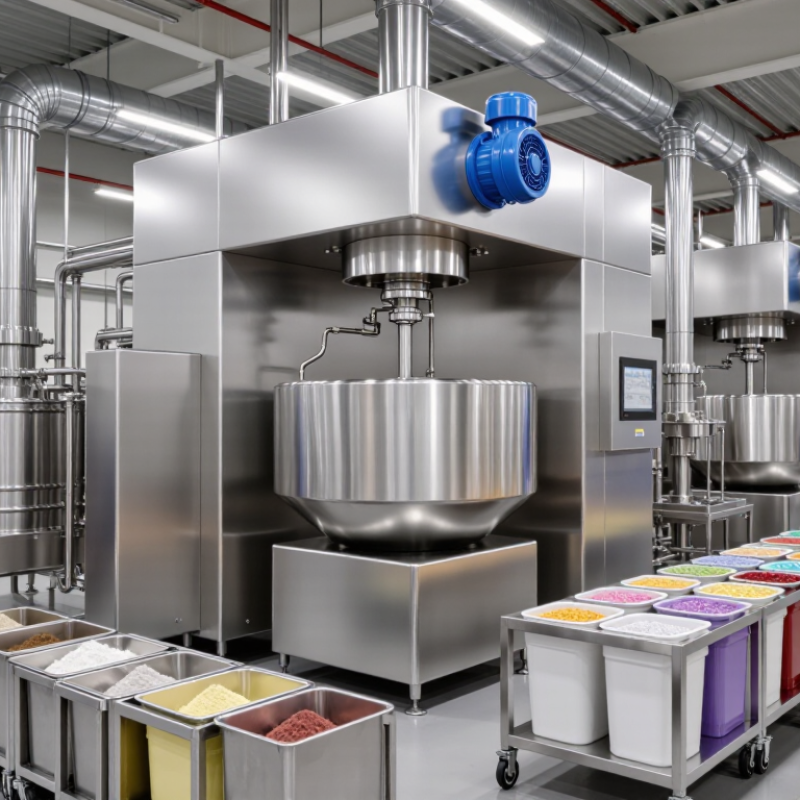
Define the Mixing Process and Material Requirements
Choosing the right mixing machine begins with defining the mixing process, not browsing equipment catalogs. Describe whether the task involves blending, dissolving, dispersing, emulsifying, or suspending materials. Each process demands different shear levels, mixing speeds, and vessel designs.
Material behavior matters just as much. Record viscosity at operating temperature, particle size, moisture content, density, and sensitivity to heat or air. A thick paste may need strong torque, while a fragile suspension can suffer from excessive shear. Note the required batch volume and target mixing time. Small laboratory tests can reveal problems that technical data sheets miss. They should not be skipped.
Think about the real production environment. Will operators add powders manually? Does the mixture stick to vessel walls? Is cleaning frequent? These details influence shaft design, access points, sealing, and temperature control. I have seen specifications focus heavily on motor power while ignoring discharge behavior. That was a costly oversight. A reliable evaluation compares test results, maintenance access, safety features, and documented material compatibility. Ask suppliers for measurable evidence, not broad performance claims. Even then, the first machine choice may need adjustment after pilot trials. Materials change, and assumptions age quickly.
How to Choose the Right Mixing Machine for Global Sourcing? - Define the Mixing Process and Material Requirements
| Mixing Process | Typical Material Profile | Indicative Viscosity | Recommended Machine Type | Shear Requirement | Typical Batch Volume | Key Material and Process Requirements | Important Sourcing Checks |
|---|---|---|---|---|---|---|---|
| Liquid blending | Water-like liquids, solvents, low-viscosity oils and solutions | Approximately 1–1,000 mPa·s | Propeller or turbine mixer | Low to medium shear | 50–10,000 L | Uniform circulation, controlled vortex, low air entrainment and compatible wetted parts | Motor power, impeller diameter, shaft speed, tank geometry, seal type and speed control |
| Powder incorporation into liquid | Powders, pigments, thickeners or salts added to water or oil phases | Approximately 1–20,000 mPa·s after incorporation | High-speed disperser or powder induction mixer | Medium to high shear | 20–5,000 L | Fast wetting, prevention of floating powder, lump reduction and dust control | Powder feed method, rotor–stator clearance, dust extraction, cleaning access and explosion-risk assessment |
| Emulsification | Immiscible liquid phases such as oil and water | Approximately 10–100,000 mPa·s | Rotor–stator emulsifier or inline high-shear mixer | High shear | 10–3,000 L per batch | Controlled droplet-size distribution, temperature management and reduced air entrainment | Rotor speed, recirculation rate, vacuum capability, seal design and validation of final particle or droplet size |
| High-viscosity blending | Creams, gels, pastes, adhesives and concentrated slurries | Approximately 10,000–1,000,000 mPa·s | Anchor, gate or helical-ribbon agitator | Low to medium shear with high torque | 50–10,000 L | Wall sweeping, adequate bottom clearance, high starting torque and optional scraper blades | Torque at start-up, gearbox service factor, heating or cooling jacket, shaft rigidity and discharge method |
| Powder blending | Dry powders, granules, pellets and free-flowing solids | Not normally expressed as liquid viscosity | Ribbon, paddle, ploughshare or conical screw mixer | Low to medium shear | 100–20,000 L | Particle-size distribution, bulk density, moisture sensitivity, segregation tendency and fill level | Explosion protection where combustible dust may be present, discharge residue, filter area and access for cleaning |
| Solid–liquid suspension | Mineral slurries, ceramic suspensions, coatings and abrasive mixtures | Approximately 10–50,000 mPa·s | Axial-flow turbine, hydrofoil or high-torque agitator | Low to medium shear | 100–20,000 L | Maintain solids uniformly, prevent settling and withstand abrasion from particles | Solids loading, particle density, wear-resistant materials, bottom geometry and required suspension speed |
| Vacuum mixing and deaeration | Air-sensitive creams, sealants, electronics compounds and viscous pastes | Approximately 10,000–10,000,000 mPa·s | Planetary vacuum mixer or vacuum-capable high-viscosity mixer | Medium shear with high torque | 1–5,000 L | Air removal, sealed vessel, controlled temperature and reliable discharge under vacuum or pressure | Vacuum level, leakage rate, vessel pressure rating, seal construction, torque monitoring and cleaning procedure |
| Temperature-controlled mixing | Materials whose viscosity, reaction rate or stability changes with temperature | Depends on formulation and operating temperature | Jacketed mixer with suitable agitator | Selected according to product sensitivity | 50–10,000 L | Required heating or cooling rate, maximum product temperature and uniform heat transfer | Jacket area, heat-transfer medium, insulation, temperature sensors, control accuracy and thermal expansion allowance |
Note: The operating ranges are indicative industry selection values. Final machine sizing should be confirmed using the actual formulation, density, solids content, rheology, batch size, temperature, cleaning method and required mixing time.